When you’re faced with an empty page and a tight deadline, or a topic you don’t know, academic writing can seem like a daunting prospect. The positive side of the story is that a good essay does not necessarily require writing it all at once. It typically involves being clear about the question, researching it, carefully planning, and revising a few times.
This guide will lead you through the process of writing your first university essay, or help you become more analytical in your writing. You will be able to understand the essay question, identify sources, develop a focused argument, organise paragraphs and proofread before submission.
1. Read and define the essay question
Read the assignment question out loud before you use a search engine or ask a writer for help. It states the lecturer’s expectations, and if one of these directions is missed, the rest of the essay may go astray.
Look for the command word. For instance, with ‘describe’ you will have to explain the key characteristics of something, and with ‘compare’ you will have to look for similarities and differences. The word ‘analyse’ generally means examining how or why, and the word ‘evaluate’ means making a judgement based on evidence. If you are not sure about these terms, please refer to the marking rubric or assignment brief for your course.
See if you can break the question into three smaller questions:
- What is the issue or problem I need to discuss?
- Which is needed: explanation, comparison, analysis or evaluation?
- Are there any restrictions, such as a specific case study, period of time, theory or word count?
For instance, when the question asks whether remote learning enhances student engagement, you should not just list the advantages of online learning. It requires evidence-based reasoning, taking into account limitations and drawing a reasonable conclusion.
2. Research for a definite purpose
Research is not the gathering of a lot of sources. It’s about looking for credible evidence that supports your answer to the question. Start at your university library with academic databases, books and peer-reviewed journal articles. Google Scholar is a good tool for finding academic information, but you should be aware that not all information will be of high quality or relevant to your research needs.
While reading, ask the following questions: Is this source relevant to your question? Who made it? When was it published, and what evidence was provided to support the information in the document? Older foundational work is not necessarily worse in every area, and a newer source is not automatically better. Select sources according to the topic and the requirements of the course.
Keep a simple source note for each useful item. It makes research easier:
- All publication information, so that you can cite it later.
- The central finding or thesis of the source, in your own words.
- A short description of how it is connected to your argument.
- The page numbers of any quotation or particular passage you may need.
Mark direct quotations clearly in your notes. This will help you to avoid accidentally plagiarising another author’s words. Use ideas and quotations appropriately, and reference them as specified by your referencing style.
3. Formulate a specific thesis statement
A thesis statement is the central direction of your essay. In many argumentative essays it presents the position you will argue for. It should answer the question and not just state the topic.
For example, this statement is not a clear claim: “This essay discusses online learning.” It could be more focused, as follows:
“Although access and flexibility can be enhanced through online learning, the impact on student engagement will depend upon the design of the course, interactions, and access to reliable technology.”
In the second version, the essay has a stance that can be evaluated using evidence.
As your research progresses, your thesis could evolve. That is normal. Adjust the claim if evidence contradicts your original thinking, rather than altering the evidence to support your opinion.
4. Use an outline as a guide to write your paper
An outline is a basic map of the essay. It enables you to decide what each section should do, and reduces the likelihood of making the same point several times in different paragraphs. Read your lecturer’s or discipline’s instructions and follow any structure they give you; not all essays follow the same structure.
A standard essay format
- Introduction: Present the topic and its context, establish important terminology (if necessary) and state the thesis or central line of argument.
- Body paragraphs: One main point per paragraph. Provide evidence, discuss the evidence, and relate it to the essay question.
- Conclusion: Sum up the key ideas, directly answer the question and make the argument clear and convincing, without adding a significant new point.
One way of planning is to write one sentence stating the aim of each paragraph. If you can’t tell what a given paragraph adds to the argument, it might need more research, a better focus or a different location in the outline.
5. Compose informative, well-supported paragraphs
When the outline is clear, start drafting. It’s easier for many students to begin with a body paragraph rather than the introduction. The introduction can be written after you have determined the direction of your essay.
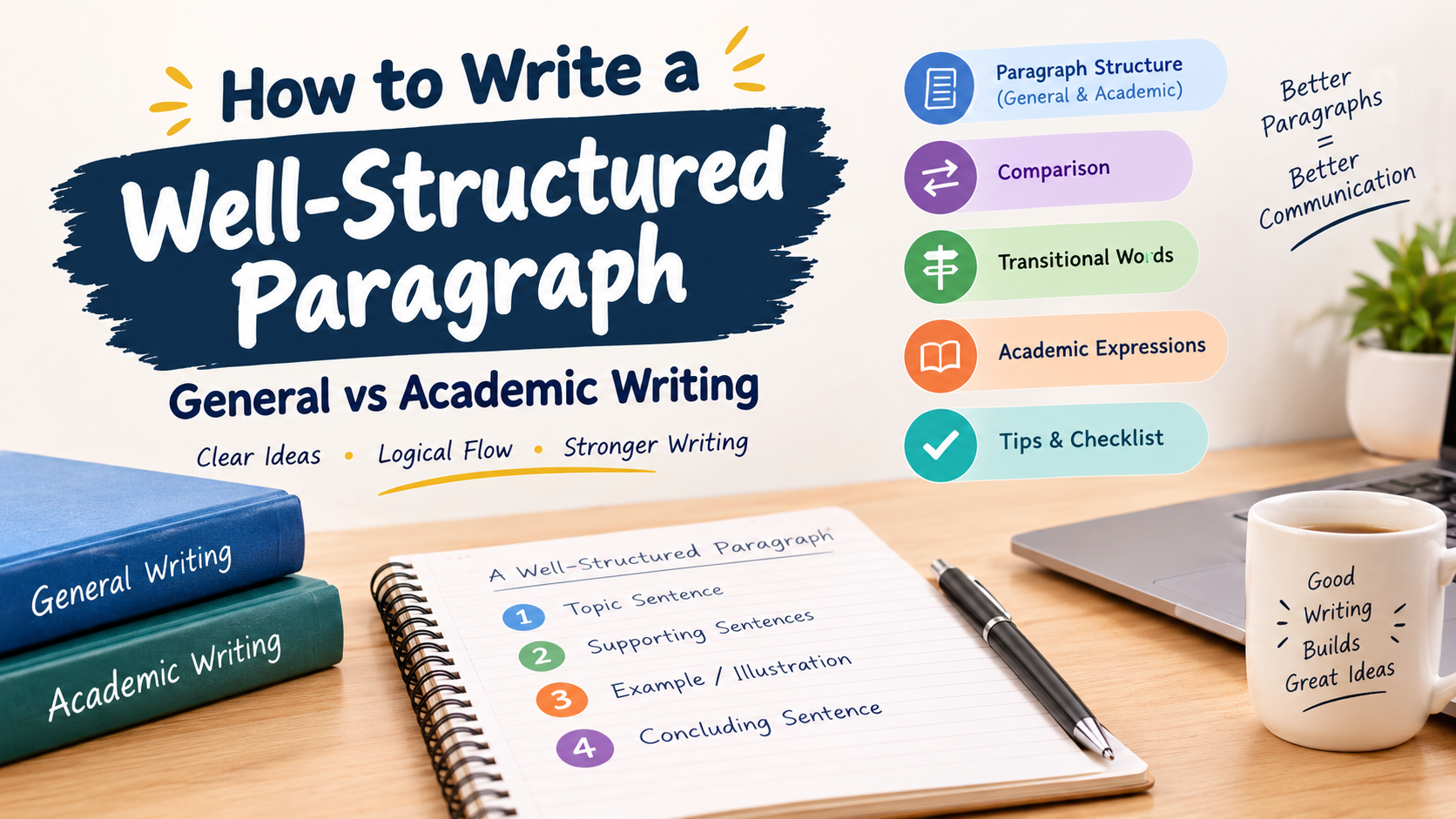
A body paragraph typically includes a point, evidence, an explanation, and a link back to the question. A few writers find it helpful to remember the PEEL method: Point, Evidence, Explanation and Link. Use it as a guide, not a rule.
Example of the approach
- Point: Flexible online learning can help to open up access to education for students with work and caring responsibilities.
- Evidence: Use a relevant, credible study or official report that analyses access or participation.
- Explanation: Say what the evidence shows, how strong it is, and whether the results can be applied to the context you are writing about.
- Link: Relate the point to the essay question and indicate how it supports your argument.
Never place a quotation in a paragraph and leave it there. The reader must know the significance of the evidence provided. Academic writing is not just a list of sources; it is your thoughtfully communicated analysis of what those sources reveal.
6. Demonstrate critical thinking, rather than just description
Description tells the reader what a source says. Critical analysis looks at the validity of the claim, the evidence to support it, how that evidence compares with other evidence, and any limitations that may be important. The typical university essay will require a balance of description and analysis, depending on the discipline and the task at hand.
As you use a source, ask yourself:
- What is the writer’s thesis, and what are the supporting details?
- Could something or someone else explain the result?
- What are the issues with this evidence?
- How can this information be used to answer my particular question?
Critical thinking is not criticism of every author. It involves making a fair and evidence-based judgement and showing the reader how you arrived at it.
7. Cite and reference ideas and information consistently
If you paraphrase or quote someone else’s ideas, findings or exact words, cite the source in the style required by your course. Common styles are APA, Harvard, MLA and Chicago, but these may differ by institution and subject. Please do not assume that one style is appropriate for all assignments.
While researching, keep information about your sources; add in-text citations as you write, and create your source list from the sources you actually used. Make sure that each in-text citation has a corresponding reference-list entry (when necessary), and that the information is correct. Follow your institution’s guidelines on quoting, paraphrasing and academic honesty.
8. Write the introduction and conclusion
The introduction
A useful introduction provides the reader with the context needed to understand the essay, explains the focus of the essay and states the thesis or central argument. Don’t begin with a general statement that is hard to back up. Get directly to the point, and make sure the introduction is proportionate to the actual length of the essay.
The conclusion
This should end with the answer to the question asked, and tie up the main ideas that support the answer. It should not copy the introduction word for word. You can describe the broader implications of your findings, but do not bring up additional evidence that needs detailed discussion.
9. Revise for argument, structure and clarity
Revision is not just about fixing spelling and grammar. If you can, take a break, then read the essay with the assignment question and marking rubric next to you. Look at the overall argument first, then paragraphs, evidence, transitions and clarity.
- Does every section answer the question?
- Does the thesis have a strong foundation, and does it continue throughout the paper?
- Is the idea in each paragraph clear?
- Have I explained the evidence, and not just inserted it?
- Do any ideas repeat, or are there statements without proof to back them up, or words that seem unnecessary?
- Are headings and transitions helpful to the reader following the argument?
10. Proofread before submission
Proofreading is the last stage of the editing process, used to catch spelling, punctuation, grammar, formatting and other minor errors. Reading the text out loud will help you identify awkward sentences, which is one of the simplest habits in academic writing. It’s also possible to look at one thing at a time (sentence clarity, citations, formatting). Automated grammar tools may flag grammatical problems, but their suggestions are not always accurate and should be considered with caution, bearing in mind your institution’s guidelines on the use of such tools.
Last but not least, verify the file format, word-count guidelines, submission place and due date. Submit only what is asked for, and keep a copy of the final file and the confirmation of submission.
Quick academic essay checklist
- I know the command word and the precise question.
- My thesis clearly addresses the question and gives my essay direction.
- My sources are accurate, credible and relevant.
- My outline follows the requirements of the assignment.
- Each paragraph has a clear idea and explains its evidence.
- I have provided analysis, not just description.
- Citations and references are in the appropriate style.
- The introduction and conclusion are consistent with the argument.
- I have revised the structure and clarity and proofread carefully.
- The rubric, word count, file format and deadline have been checked.
Some of the most frequent errors
- Starting to write before analysing the task: Find out the command word, the scope and the assessment criteria first.
- Collecting sources without evaluating them: Check their credibility and relevance, and explain how the evidence backs up your argument.
- Describing instead of analysing: Discuss significance, limitations and connections to the question.
- Waiting until the end to record source details and cite: Record source information and cite as you draft.
- Handing in the first draft: Allow time for substantive revision and editing.
- Judging by the similarity score alone: Proper attribution and following academic rules matter; a score is not proof of plagiarism-free work.
Frequently asked questions
What is a good length for a college essay?
Follow the word count in your assignment brief. The right length depends on the course, the level and the task; do not replace the length your lecturer has specified with a figure you found on the internet.
Is it OK to write the introduction at the end?
Yes. Some students write the body first and then write or edit the introduction to make the argument clear. The final introduction must still sit at the start and describe the essay properly.
How many sources will I need?
There is no universal number. Follow the instructions and expectations for the assignment in your discipline, and use enough high-quality sources to answer the question well.
What’s the difference between proofreading and editing?
Editing improves the argument, structure, clarity and style. Proofreading identifies the remaining errors in language, punctuation, formatting and typography.
Can AI tools help me write an essay?
They may help to explain concepts, brainstorm questions or deal with language problems, where this is allowed. Check all information, protect private information, disclose use when required and follow your institution’s academic honesty policy. If your institution forbids submitting work written by AI, don’t do it.
Looking for tips on academic writing?
Drafts can be challenging to work with if you don’t know whether your argument is clear, your paragraphs are logical or your references are consistent. With structured feedback, you can find out what needs improvement. Scribe Scholars offers academic assistance and research direction to help students understand what is expected and strengthen their research skills.