A well-structured paragraph is one of the most important elements of effective writing. Whether you are writing a school assignment, a university essay, a blog post, or a research paper, organising your ideas clearly helps readers understand your message. However, writing a paragraph involves more than putting several sentences together. Each sentence should contribute to a central idea, and the ideas should follow a logical sequence. In this guide, you will learn how to write a well-structured general paragraph, understand the structure of an academic paragraph, compare the two writing styles, and use transitional words and academic expressions to improve your writing.
1. What Is a Well-Structured Paragraph?
A well-structured paragraph is a group of related sentences that develops one central idea in a clear and logical manner. Every sentence should contribute to the paragraph's main purpose, and the relationship between sentences should be easy for readers to follow.
A well-written paragraph generally demonstrates five essential qualities:
- Unity: All sentences focus on one central idea.
- Coherence: Ideas are arranged in a logical order.
- Cohesion: Transitional words and other linguistic devices connect sentences smoothly.
- Adequate development: The main idea is supported with relevant explanations, details, or examples.
- Correctness: Grammar, spelling, punctuation, and word choice are appropriate.
These principles apply to both general and academic writing, although expectations for evidence, tone, and analysis may differ.
2. The Four Essential Parts of a General Paragraph
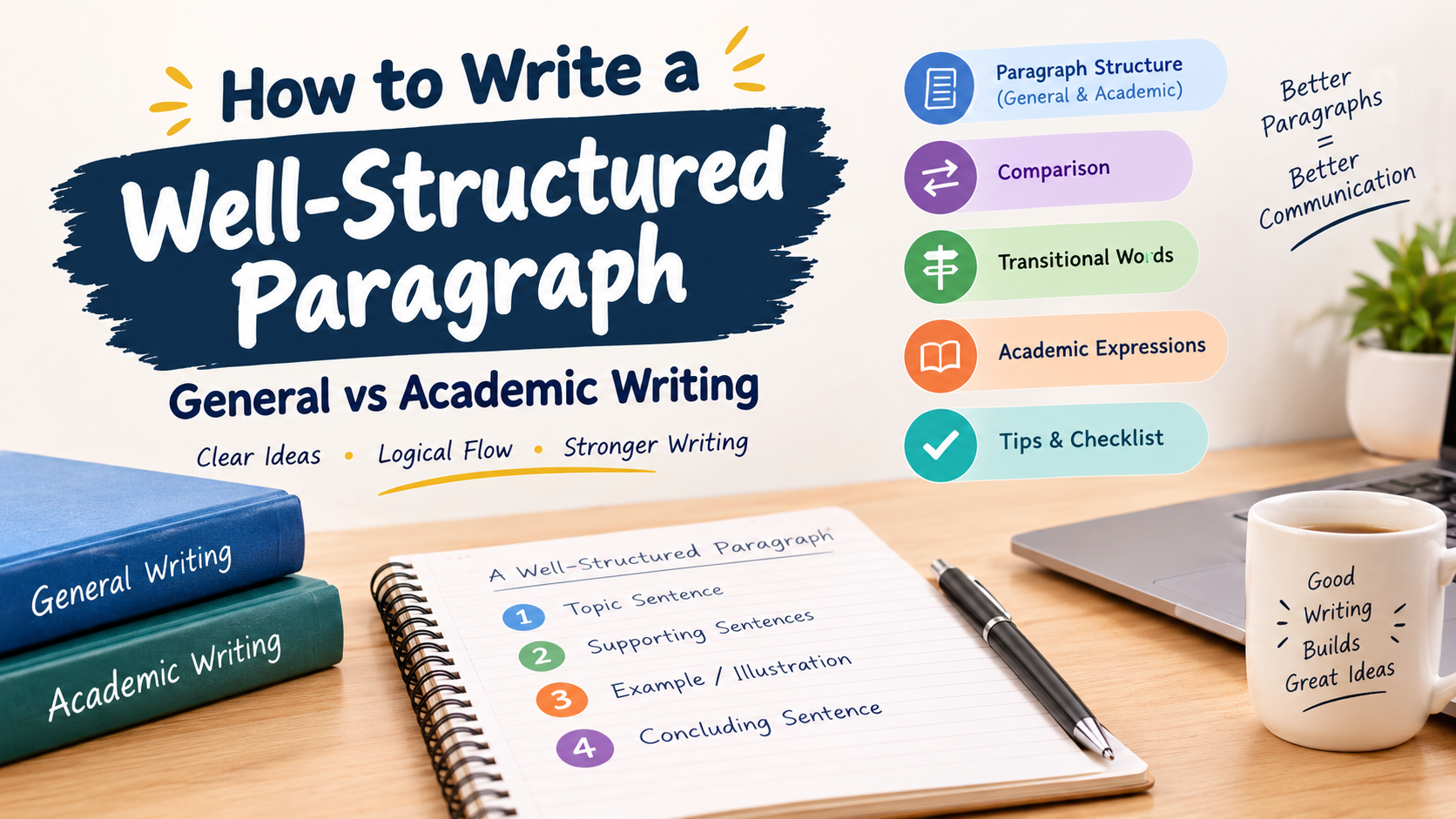
A general paragraph can be organised into four basic parts: a topic sentence, supporting sentences, an example or illustration, and a concluding sentence.
2.1 Topic Sentence
The topic sentence introduces the paragraph's main idea. It establishes the subject and helps readers understand what the paragraph will discuss.
Example: Reading books is essential for personal and intellectual development.
This sentence establishes reading as the central topic and indicates the direction of the discussion.
2.2 Supporting Sentences
Supporting sentences explain or develop the topic sentence. They may provide reasons, descriptions, details, causes, or effects.
Example: Books expand our knowledge, improve our vocabulary, and develop our critical thinking skills. Regular reading also helps us understand different cultures, perspectives, and experiences.
These sentences explain why reading is beneficial and develop the main idea introduced in the topic sentence.
2.3 Example or Illustration
An example makes an explanation more concrete and helps readers understand the main idea.
Example: For instance, students who read regularly may develop stronger comprehension skills and become more confident in expressing their ideas.
Examples should be relevant to the topic and should clarify the point being discussed.
2.4 Concluding Sentence
The concluding sentence reinforces the main idea or presents a final observation. It should provide a sense of completion without introducing an unrelated topic.
Example: Therefore, regular reading is a valuable habit that contributes to lifelong learning and personal growth.
A concluding sentence is useful in many paragraphs, although it is not compulsory in every writing situation.
3. Example of a Well-Structured General Paragraph
Topic: The Importance of Education
Education plays a vital role in the personal and social development of individuals. It equips people with knowledge, develops critical thinking skills, and enables them to make informed decisions. Moreover, education increases employment opportunities and promotes social awareness. For example, educated citizens are better equipped to understand their rights, participate in civic activities, and contribute to national development. Thus, education is not merely a means of securing employment; it is also a powerful instrument for individual empowerment and social progress.
This paragraph begins with a central idea, develops it through supporting details, provides an example, and ends with a concluding statement. All the sentences contribute to the same topic.
4. What Is an Academic Paragraph?
An academic paragraph is a group of logically organised sentences that develops a specific claim, argument, or analytical point using explanation, evidence, and reasoning. It is commonly used in university assignments, essays, research papers, literature reviews, and other scholarly writing.
Unlike a paragraph that simply describes a topic, an academic paragraph often explains why a claim is reasonable, what evidence supports it, and what conclusions can be drawn from that evidence.
Academic writing generally requires a formal and precise style. Depending on the assignment, it may also require citations from credible academic sources.
5. The Structure of an Academic Paragraph: PEEL
One useful framework for developing an academic paragraph is PEEL, which stands for Point, Evidence, Explanation, and Link.
5.1 Point
The point introduces the main claim or argument of the paragraph.
Example: Digital technology can improve access to educational resources for university students.
The sentence presents a focused claim that can be explained and supported.
5.2 Evidence
Evidence supports the claim through relevant research findings, statistics, scholarly sources, or carefully selected examples.
Example: Research on digital learning may provide evidence about how online platforms influence students' access to educational materials.
In a formal assignment, replace this general reference with a specific, verified source and an appropriate citation. Never invent research findings or statistics.
5.3 Explanation
The explanation interprets the evidence and shows how it supports the main point.
Example: Online platforms allow students to access recorded lectures, digital textbooks, and learning materials beyond the time and geographical limitations of traditional classrooms.
This sentence explains a possible mechanism through which technology can improve access.
5.4 Link
The linking sentence connects the discussion back to the central claim or to the broader argument of the essay.
Example: Consequently, digital learning can make educational resources more accessible, although its effectiveness depends on internet connectivity, digital literacy, and the quality of learning materials.
PEEL is a flexible writing framework, not a compulsory formula. Evidence may appear before or after an explanation, and some paragraphs may need more than one piece of evidence or a more extensive critical analysis.
6. Example of a Well-Developed Academic Paragraph
Topic: The Impact of Digital Technology on Education
Digital technology can improve students' access to educational resources by reducing some of the geographical and temporal barriers associated with traditional learning. Online learning platforms allow students to access recorded lectures, electronic textbooks, and supplementary materials beyond the physical classroom. For example, a university student in a rural area of Bangladesh may use online educational resources to supplement the materials available at their institution. This example illustrates how digital platforms can broaden access to learning opportunities. However, the benefits are not equally available to all students because reliable internet connectivity, suitable devices, and digital literacy remain important requirements. Therefore, digital technology can support more flexible and accessible education, but its effectiveness depends on the availability of appropriate infrastructure and learning support.
This paragraph follows an academic approach because it presents a clear claim, explains the claim, illustrates its application, and evaluates a relevant limitation. In a research paper, the argument should also be supported with verified sources where appropriate.
7. General Paragraph vs Academic Paragraph
Although both types of paragraphs require unity, coherence, cohesion, and grammatical accuracy, they differ in purpose, style, and expectations.
| Feature | General Paragraph | Academic Paragraph |
|---|---|---|
| Main purpose | To describe, narrate, explain, or inform | To explain, analyse, evaluate, or support an argument |
| Language | May be conversational or informal | Generally formal, precise, and discipline-appropriate |
| Tone | May express personal feelings and opinions | Usually measured, objective, and evidence-conscious |
| Supporting details | May use personal experiences and familiar examples | Often uses reasoned explanations and credible evidence |
| Sources | Usually optional | Required when using others' ideas or research, according to citation requirements |
| Analysis | May be simple or descriptive | Often explains the significance and implications of evidence |
| Vocabulary | Everyday language may be sufficient | Precise or subject-specific terminology may be necessary |
| Conclusion | May summarise the central idea | Often links the analysis to the main claim or wider argument |
The distinction is not absolute. General writing can be analytical, and academic writing can be accessible and straightforward. The appropriate style depends on the audience, purpose, discipline, and task requirements.
8. Transitional Words and Phrases for Better Paragraph Writing
Transitional words and phrases establish relationships between ideas. They help readers understand whether a sentence adds information, introduces an example, explains a cause, presents a contrast, or draws a conclusion.
8.1 Addition
Use these expressions to introduce another related point.
- Furthermore
- Moreover
- In addition
- Additionally
- Also
- Besides
Example: Regular reading improves vocabulary. Furthermore, it helps students develop stronger comprehension skills.
8.2 Examples and Illustrations
- For example
- For instance
- To illustrate
- Specifically
- Such as
Example: Digital resources can support independent learning. For instance, students can use online dictionaries to understand unfamiliar words.
8.3 Cause and Effect
- Therefore
- Consequently
- As a result
- Thus
- Hence
- Accordingly
Example: Many students lack access to physical libraries. As a result, digital resources may provide an additional source of learning materials.
8.4 Contrast and Concession
- However
- Nevertheless
- In contrast
- On the other hand
- Although
- Even though
- Despite this
Example: Online learning offers flexibility. However, students may struggle when they lack reliable internet access.
8.5 Sequence and Order
- First
- Second
- Next
- Subsequently
- Finally
- To begin with
Example: First, identify the main claim. Next, select relevant supporting evidence. Finally, explain how the evidence supports the claim.
8.6 Explanation and Clarification
- In other words
- That is
- More specifically
- This means that
- To put it differently
Example: Academic writing requires precision. In other words, writers should express their claims clearly and avoid unsupported generalisations.
8.7 Emphasis
- Indeed
- In particular
- Notably
- Above all
- Significantly
Example: Access to reliable information is important for academic success. Notably, students must also evaluate the credibility of their sources.
8.8 Conclusion and Summary
- In conclusion
- Overall
- To sum up
- In summary
- Ultimately
- Therefore
Example: Overall, effective paragraph writing requires a clear central idea, logical development, and appropriate connections between sentences.
Writing tip: Do not use transitional words mechanically. A transition should reflect the actual relationship between ideas. For example, "however" signals contrast, whereas "therefore" signals a conclusion or result.
9. Academic Expressions vs General Expressions
Academic writing often uses more precise, measured, and formal expressions than everyday writing. However, academic language should not be unnecessarily complicated. The objective is to communicate ideas accurately and professionally.
| General Expression | Academic Expression |
|---|---|
| A lot of people think that... | Many people believe that... |
| This shows that... | This suggests that... |
| Things got worse. | Conditions deteriorated. |
| The results were good. | The results were favourable. |
| The study looked at... | The study examined... |
| This is a big problem. | This presents a significant challenge. |
| People use the internet to find things. | Individuals use the internet to access information. |
| The government should do something. | The government should implement appropriate measures. |
| There are many reasons for this. | Several factors may account for this. |
| This proves that... | This provides evidence that... |
| Kids learn better when... | Children may learn more effectively when... |
| It is bad for the environment. | It has adverse environmental effects. |
| We can see that... | The findings indicate that... |
| Everyone knows that... | It is widely recognised that... |
| In the end... | Ultimately... |
These are contextual alternatives, not universal replacements. For example, "proves" should be used only when the strength of the evidence justifies it. In research writing, "suggests," "indicates," or "provides evidence for" may be more accurate.
10. Common Mistakes to Avoid
1. Writing without a clear topic sentence: Readers should be able to identify the paragraph's central idea.
2. Including unrelated information: Every supporting sentence should contribute to the main point. Move unrelated ideas into separate paragraphs.
3. Repeating the same idea: Develop your point by adding a new reason, explanation, example, or implication rather than repeating the same claim.
4. Using evidence without analysis: A quotation, statistic, or example does not automatically strengthen an argument. Explain what the evidence means and how it supports your point.
5. Overusing transitional words: Using "moreover," "furthermore," and "therefore" in every sentence can make writing repetitive. Use transitions only when they improve the logical connection.
6. Using unnecessarily complex vocabulary: Prefer accurate and natural language over complicated expressions that obscure your meaning.
7. Making unsupported generalisations: Avoid absolute statements such as "Technology always improves education" unless they can genuinely be justified. Academic arguments should reflect the available evidence and acknowledge relevant limitations.
11. A Practical Checklist Before Submitting Your Paragraph
Before submitting a paragraph for an assignment or examination, check the following points:
- Does the paragraph have one clear central idea?
- Does the topic sentence express that idea accurately?
- Are the supporting sentences relevant?
- Have I explained the relationship between my claim and the supporting details?
- Have I used examples or credible evidence where necessary?
- Are the sentences logically connected?
- Have I used transitional expressions appropriately?
- Is the language suitable for the audience and purpose?
- Have I checked grammar, spelling, and punctuation?
- If I used another author's ideas or research, have I cited the source correctly?
Conclusion
Writing a well-structured paragraph requires more than grammatical accuracy. It requires a clear central idea, relevant supporting details, logical organisation, and effective connections between sentences. General paragraphs may focus on description, narration, or straightforward explanation, whereas academic paragraphs commonly develop claims through evidence, reasoning, and analysis.
By practising paragraph structure, using transitional expressions purposefully, and choosing precise language, students can improve the clarity and effectiveness of their writing. Whether you are preparing for an examination or completing a university assignment, these principles provide a strong foundation for developing clear, coherent, and well-supported paragraphs.