Editing is one of the most important stages of academic writing, yet many students underestimate it. After spending hours researching, planning, and writing an assignment, it is tempting to check the word count, run a spellchecker, and submit the work immediately. However, even a well-researched assignment can lose clarity and impact because of weak paragraph structure, unsupported arguments, inconsistent referencing, or small grammatical errors.
The good news is that effective editing does not require perfect English or professional editing software. A systematic review can help you identify problems, strengthen your arguments, and present your ideas more clearly. This guide provides a practical academic editing checklist that you can use before submitting essays, reports, research papers, and other university assignments.
In this guide, you will learn how to:
- Improve the structure and logical flow of an assignment.
- Check whether your arguments answer the assignment question.
- Identify grammar, punctuation, and sentence-level problems.
- Review citations, references, and academic integrity.
- Use a final checklist before submitting your work.
1. What Is Academic Editing?
Academic editing is the process of reviewing and improving a piece of academic writing so that it communicates ideas clearly, logically, and accurately. It involves examining the content, structure, argument, language, evidence, and presentation of an assignment.
Editing is not simply about correcting spelling mistakes. It also means checking whether each paragraph contributes to your argument, whether your evidence supports your claims, and whether your conclusion follows logically from your discussion.
It is useful to distinguish between three related activities:
- Revising: Improving the content, argument, organisation, and overall direction of your work.
- Editing: Improving sentence structure, clarity, word choice, academic tone, and consistency.
- Proofreading: Checking the final version for spelling, punctuation, formatting, and other surface-level errors.
These activities overlap, but treating them as separate stages can make the process more manageable. Start with the biggest issues before concentrating on individual words and punctuation marks.
2. Check Whether You Have Answered the Assignment Question
Before correcting grammar, return to the assignment brief. A grammatically accurate essay may still be unsuccessful if it does not answer the question or meet the assessment requirements.
Read the question again and identify its main instruction. For example, an assignment asking you to critically evaluate a theory requires more than a description of the theory. You may need to examine evidence, compare perspectives, consider limitations, and reach a reasoned judgement.
Ask yourself the following questions:
- Have I answered the exact question rather than a related topic?
- Have I addressed every part of the task?
- Have I followed the required format and word limit?
- Have I considered the assessment criteria or marking rubric?
- Does each main section contribute to the purpose of the assignment?
- Have I followed the instructions about sources, evidence, and referencing?
If you discover that an important part of the question has not been addressed, revise the content before spending time on minor language errors.
3. Review Your Introduction, Main Body, and Conclusion
A well-organised assignment helps readers understand your argument without unnecessary effort. The introduction should establish the topic and purpose, the main body should develop the discussion, and the conclusion should bring the argument together.
Introduction checklist
- Does the introduction establish the topic and provide relevant context?
- Is the purpose of the assignment clear?
- Have I introduced the main question, issue, or problem?
- Does the introduction provide a clear direction for the discussion?
- Have I avoided unnecessary background information?
Main body checklist
- Does each section have a clear purpose?
- Does each paragraph develop one main point?
- Are claims supported by relevant evidence or credible sources?
- Have I explained how the evidence supports my argument?
- Do paragraphs connect logically to one another?
- Have I included analysis rather than relying entirely on description?
Conclusion checklist
- Does the conclusion directly answer the assignment question?
- Have I summarised the most important findings or arguments?
- Does the conclusion follow from the evidence discussed?
- Have I avoided introducing substantial new arguments?
- Have I avoided simply repeating the introduction word for word?
Remember that different assignments require different structures. A laboratory report, reflective essay, business report, and literature review may have different conventions. Always follow your university's instructions and the requirements of your specific task.
4. Check Paragraph Structure and Logical Flow
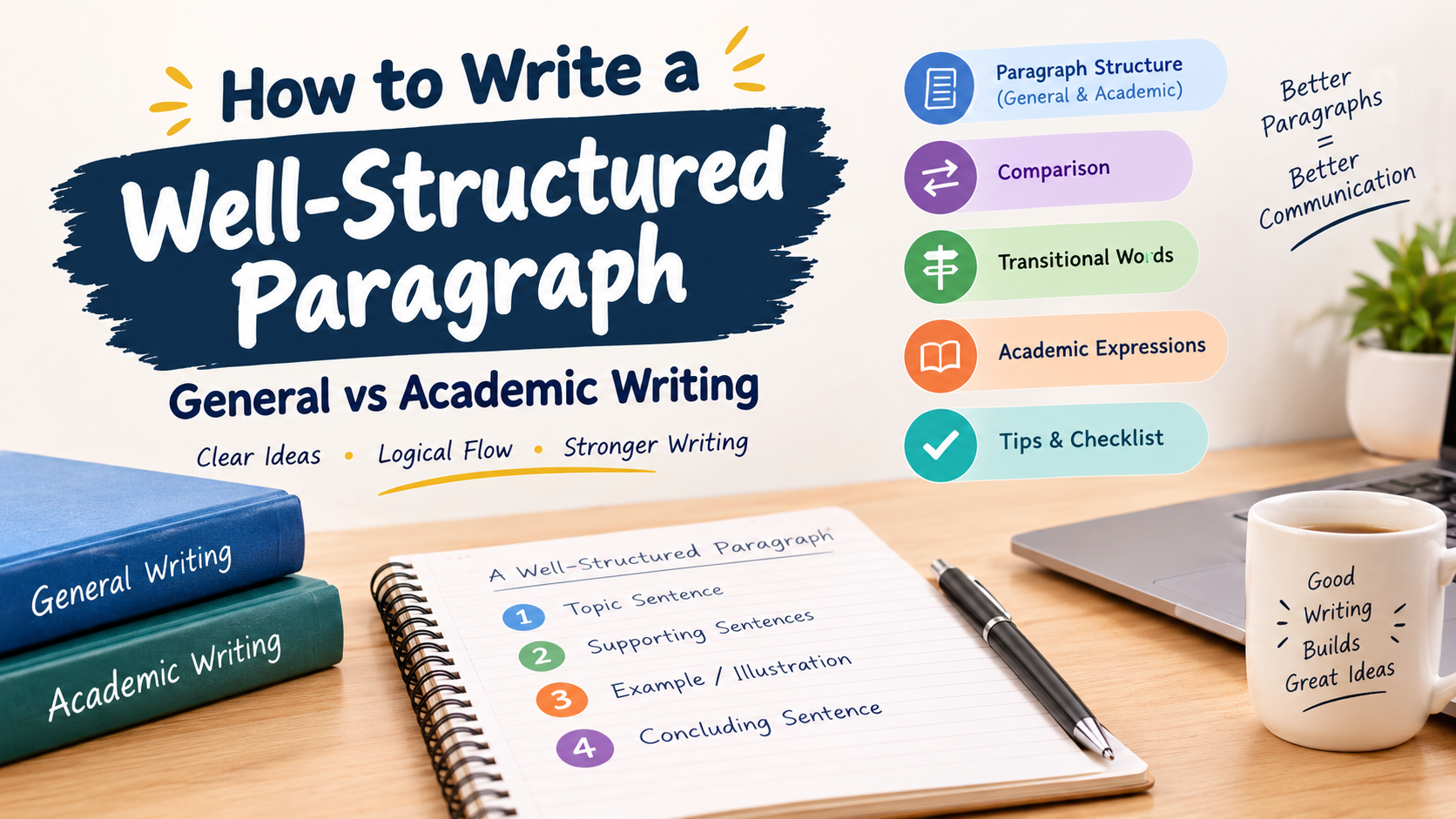
Strong academic paragraphs usually contain a clear central point, relevant supporting material, and an explanation of why that material matters. Not every paragraph must follow an identical formula, but readers should be able to understand the purpose of each one.
Use this checklist when reviewing individual paragraphs:
- Does the paragraph have a clear central idea?
- Is the supporting evidence relevant to that idea?
- Have I explained or analysed the evidence?
- Does the paragraph connect to the wider argument?
- Is the transition from the previous paragraph clear?
- Have I removed repetition and unrelated information?
Consider the following example.
Less effective:
Online learning is popular. Many students use online learning. Online learning has several benefits. Students can study at home.
Improved version:
Online learning offers greater flexibility by allowing students to access course materials outside traditional classroom hours. This flexibility can help learners balance their studies with employment or family responsibilities. However, its effectiveness may depend on students' access to reliable technology, appropriate learning support, and opportunities for interaction.
The improved paragraph develops a central point, explains its significance, and introduces a relevant limitation. This makes the discussion more informative and analytical.
5. Strengthen Your Academic Arguments
Academic writing requires more than presenting information from books, journal articles, or websites. You must explain what the information means and how it supports your position.
During editing, look for statements that make claims without sufficient explanation. Ask whether a reader could reasonably ask, "How do you know?" or "Why does this matter?" If so, your argument may need stronger evidence or clearer analysis.
Use the following questions to review your reasoning:
- Have I supported important factual claims with suitable evidence?
- Have I explained the relevance of the evidence instead of merely quoting it?
- Have I considered alternative interpretations or counterarguments where appropriate?
- Have I distinguished my interpretation from the findings of other researchers?
- Have I avoided making claims that are broader than the evidence allows?
- Does my overall argument remain consistent throughout the assignment?
For example, writing that a teaching method is effective is not enough on its own. An effective discussion should identify the relevant evidence, explain what it demonstrates, consider the context, and acknowledge limitations where necessary.
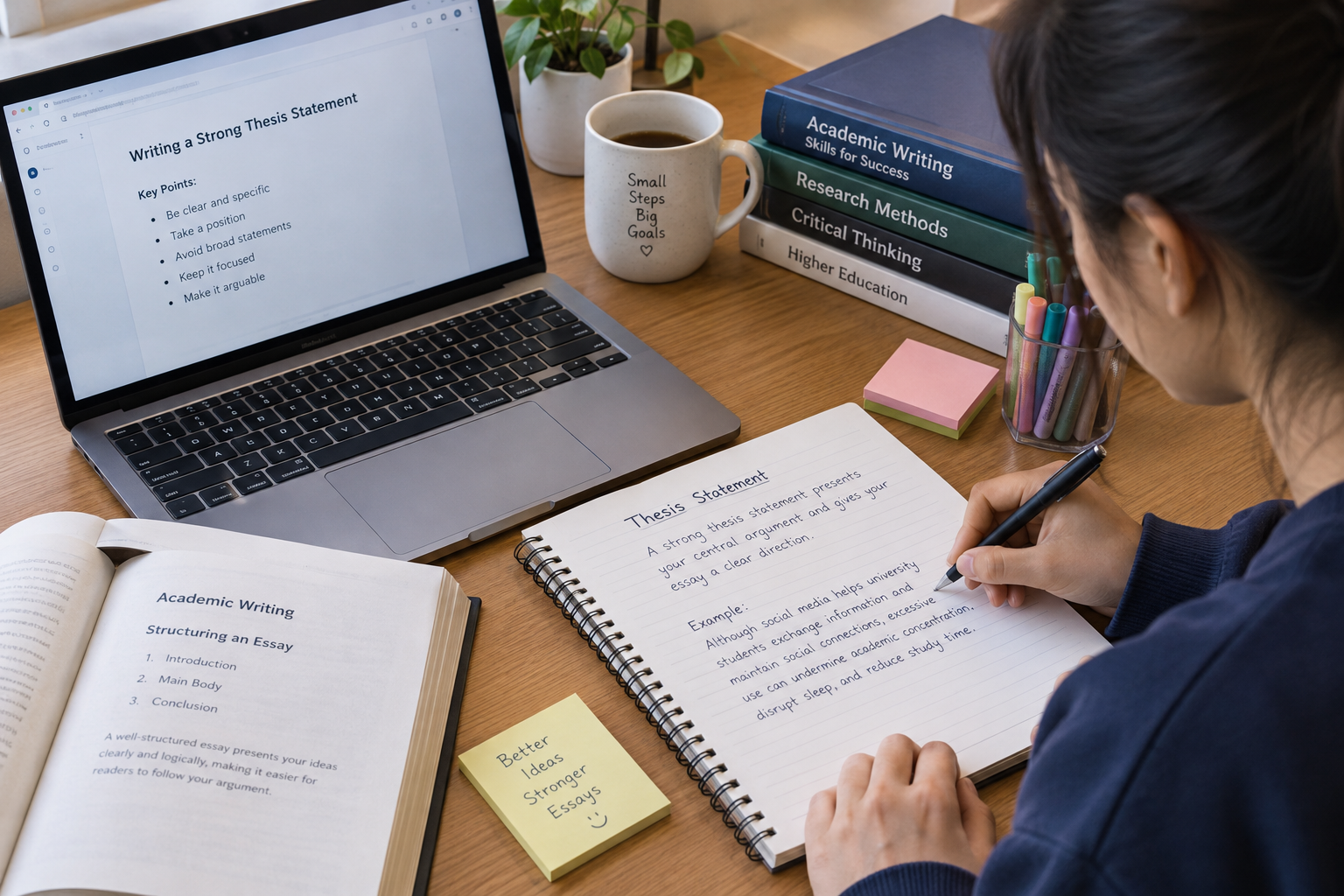
For more guidance, read our guide on how to write a strong thesis statement and our article on critical vs descriptive writing.
6. Improve Grammar, Sentence Structure, and Punctuation
Once the content and structure are sound, examine the language carefully. Grammar and punctuation errors can make your ideas difficult to understand, even when the underlying argument is strong.
Check the following areas:
- Subject–verb agreement: Make sure the subject and verb agree in number.
- Verb tense: Use tenses consistently and appropriately for the context.
- Sentence fragments: Check that sentences express complete thoughts.
- Run-on sentences: Correct sentences that join independent clauses incorrectly.
- Comma usage: Check commas in introductory phrases, lists, and complex sentences.
- Articles: Review the use of a, an, and the.
- Pronouns: Ensure that pronouns have clear references.
- Spelling: Correct misspelled words and commonly confused terms.
- Capitalisation: Apply consistent rules for headings, names, and titles.
Do not automatically make every sentence longer or more complicated to sound academic. Clear, precise sentences are generally more effective than unnecessarily complex ones.
Example: Correcting a common grammar error
Incorrect: The results of the study shows a significant difference.
Correct: The results of the study show a significant difference.
The subject is results, which is plural, so the verb should be show, not shows.
7. Use an Appropriate Academic Tone
An academic tone is generally clear, precise, evidence-based, and appropriate for the discipline. It does not mean filling every sentence with technical vocabulary or avoiding simple words.
Review your work for language that is too informal, vague, emotional, or unnecessarily absolute.
| Less suitable wording | Possible improvement |
|---|---|
| A lot of people think... | Many researchers argue... |
| This proves that... | This suggests that... |
| The results are really bad. | The results indicate substantial limitations. |
| Everyone knows that... | Available evidence indicates that... |
| I think this is a good idea. | The evidence supports this approach because... |
These alternatives are not interchangeable in every situation. Choose wording that accurately reflects your evidence and the conventions of your subject. First-person language may be appropriate in reflective assignments or disciplines where it is accepted.
8. Verify Your Citations and Reference List
Referencing is an essential part of academic integrity. It allows readers to identify the sources behind your claims and distinguishes your own contribution from the ideas of other authors.
Referencing requirements differ across institutions and disciplines. Your assignment may require APA, Harvard, MLA, Chicago, IEEE, or another style. Always follow the specific instructions provided by your university or lecturer.
Use this referencing checklist:
- Have I cited the sources of borrowed ideas, data, quotations, and other material where required?
- Does every in-text citation correspond to an entry in the reference list, where the chosen style requires it?
- Have I checked that the author names and publication years are accurate?
- Are direct quotations reproduced accurately and formatted correctly?
- Have I included page numbers or other location details when required by the referencing style?
- Are the reference entries complete and consistently formatted?
- Have I checked the details of each source against the original publication?
- Have I avoided citing sources that I have not actually consulted or verified?
Do not assume that a reference generator or citation-management tool is always accurate. These tools can save time, but imported metadata may contain errors, missing details, or inconsistent formatting.
If you use AI tools during your work, check your institution's rules on permitted use and disclosure. AI-generated references, quotations, and factual claims should never be treated as reliable without verification.
9. Check for Plagiarism and Responsible Source Use
Before submitting an assignment, make sure that your writing represents your own work and that the contributions of other authors are acknowledged appropriately.
Pay particular attention to paraphrasing. Changing a few words in a sentence does not necessarily make it an acceptable paraphrase. You should understand the original idea, express it in your own wording and sentence structure, and provide a citation when the idea comes from a source.
- Have I clearly marked and cited direct quotations?
- Have I paraphrased sources genuinely rather than replacing a few words with synonyms?
- Have I cited borrowed ideas even when I have written them in my own words?
- Have I avoided copying material from websites or other students without acknowledgement?
- Have I followed my institution's policy on collaboration and AI-assisted writing?
- Have I verified that any similarity report is interpreted in context rather than treated as a definitive judgement?
A similarity score does not automatically establish plagiarism, and a low score does not guarantee that an assignment meets academic-integrity requirements. Review the matched material, your citations, and your institution's guidance.
For additional support, read our guide on how to write an academic essay and check your university's official academic-integrity policy.
10. Check Tables, Figures, and Formatting
Presentation affects how easily readers can follow your work. Formatting errors may also indicate that the assignment has not been checked against the submission requirements.
Review the following details:
- Are headings and subheadings consistent?
- Is the font, size, spacing, and margin format consistent with the instructions?
- Are page numbers included where required?
- Are tables and figures numbered and titled appropriately?
- Have you referred to important tables and figures in the main text?
- Are images, charts, and other visual materials properly attributed where necessary?
- Is the file in the required format, such as DOCX or PDF?
- Does the filename follow any instructions provided by the institution?
- Have you removed unnecessary comments, tracked changes, and drafting notes?
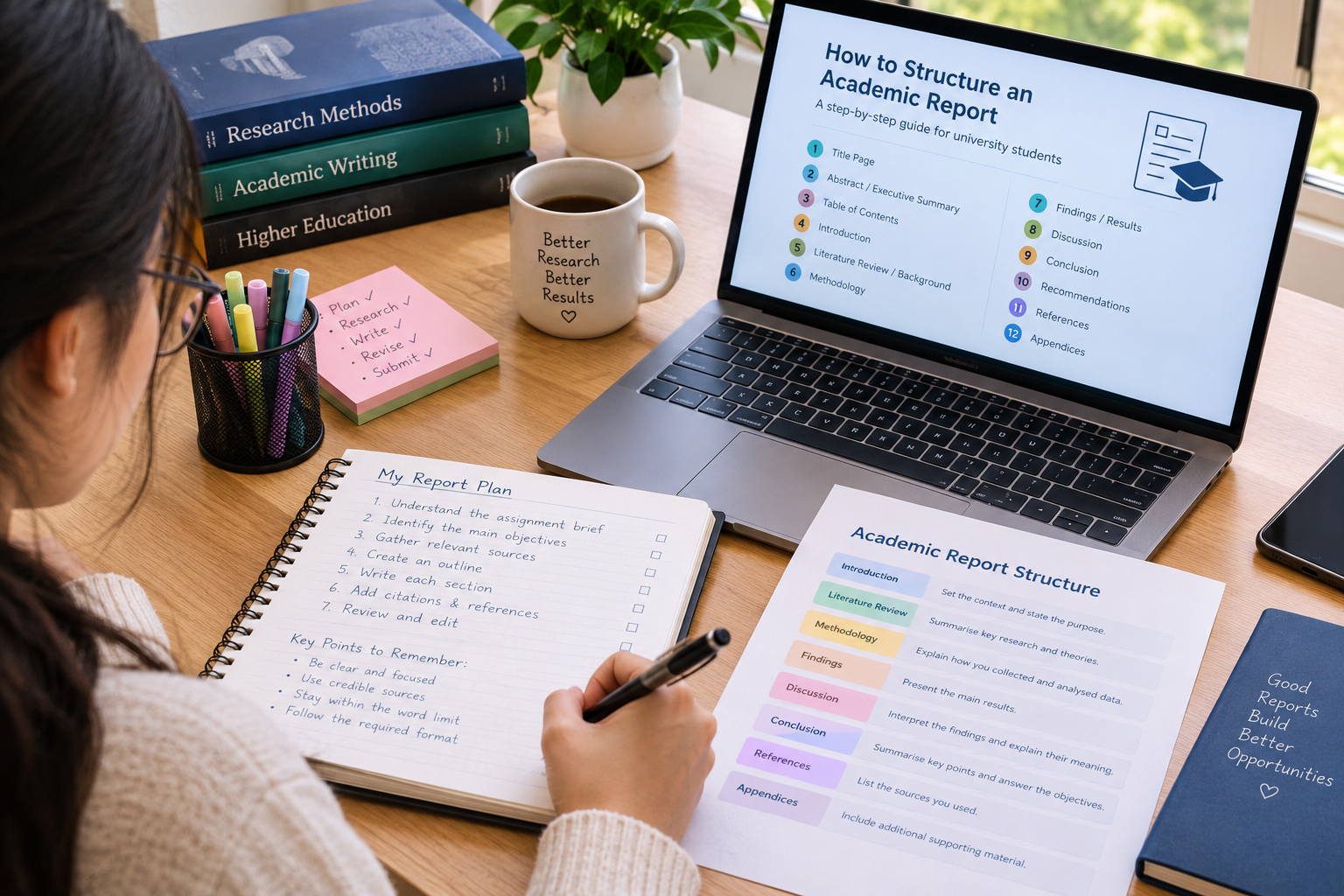
If you are preparing a report, dissertation, or research paper, also check whether the table of contents, headings, page references, appendices, and reference list match the final document.
11. Read Your Assignment from a Reader's Perspective
Writers often overlook errors because they already know what they intended to say. A separate reading pass can help you identify unclear explanations, missing transitions, and sentences that sound correct in your head but are confusing on the page.
Try these practical techniques:
- Take a short break: If your deadline allows, step away from the document before editing it.
- Read aloud: This can reveal awkward phrasing, repetition, and sentences that are difficult to follow.
- Read one sentence at a time: Concentrate on grammar, punctuation, and