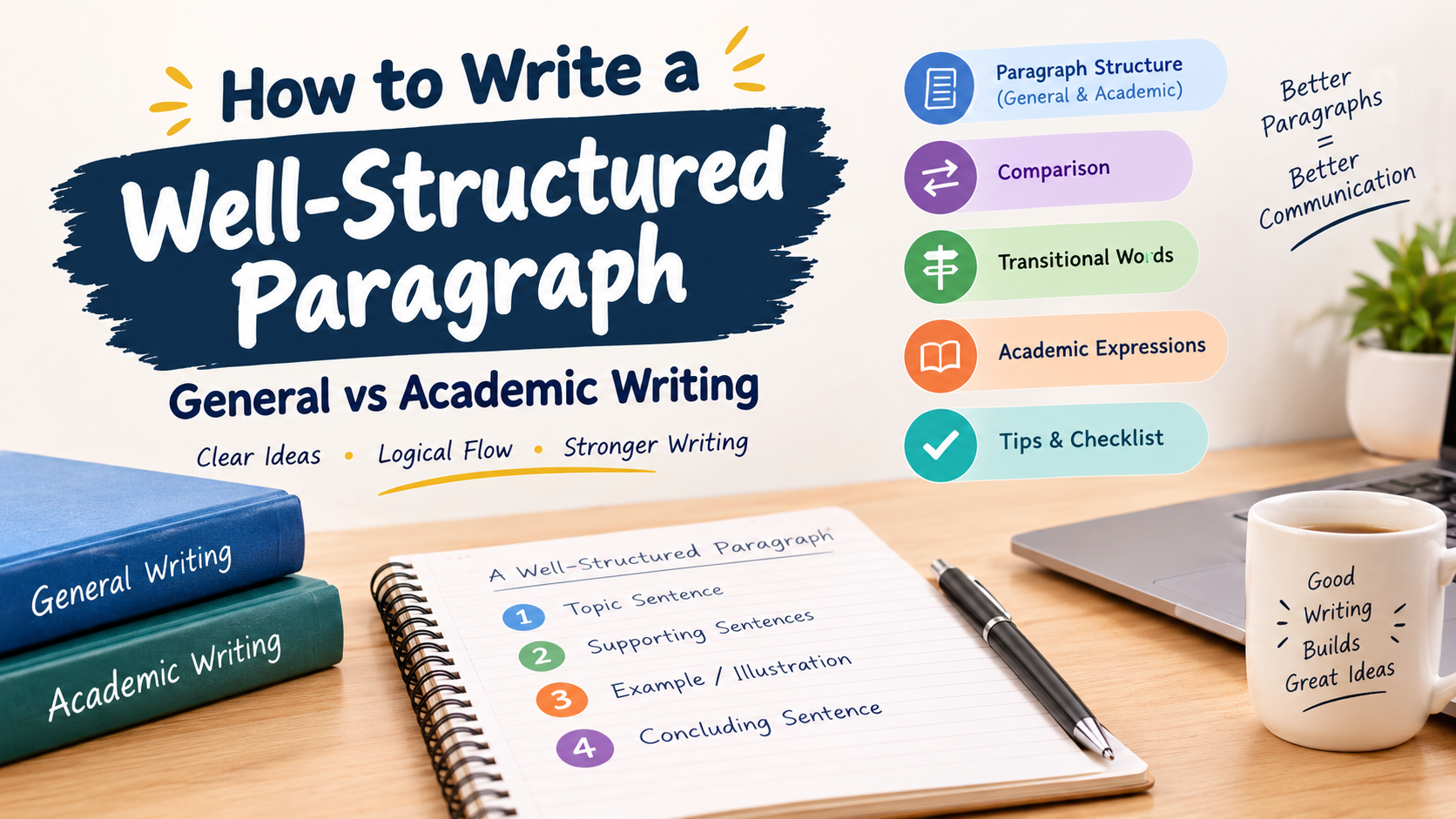
Many university students can describe a topic clearly but struggle when an assignment asks them to analyse, evaluate, or critically discuss an idea. This is because academic writing requires more than explaining information. Students must also interpret evidence, examine different perspectives, and develop reasoned arguments. Understanding the difference between critical and descriptive writing can help you produce stronger assignments and achieve better academic results.
In this guide, we explain what descriptive and critical writing mean, how they differ, when to use each approach, and how to develop a more critical academic writing style.
Key takeaway: Descriptive writing tells the reader what something is or what happened. Critical writing examines why it matters, how convincing the evidence is, and what conclusions can reasonably be drawn.
What Is Descriptive Writing?
Descriptive writing presents information about a subject, explains concepts, summarises research, or reports what an author has said. It helps readers understand the background and essential facts of a topic.
In university assignments, descriptive writing is useful when you need to define a concept, introduce a theory, explain a process, or provide context before analysing an issue.
Example of descriptive writing:
"Online learning allows students to access educational materials through digital platforms. It can include recorded lectures, live classes, online discussions, and electronic assessments. Many universities use online learning systems to support teaching and student communication."
This paragraph explains what online learning is and identifies some of its features. However, it does not evaluate whether online learning is effective, examine its limitations, or compare evidence about its educational value.
What Is Critical Writing?
Critical writing goes beyond presenting facts. It involves examining ideas, evaluating evidence, comparing viewpoints, identifying limitations, and developing a justified conclusion.
Being critical does not mean finding fault with everything. Instead, it means approaching information thoughtfully, questioning assumptions where appropriate, and explaining why a particular interpretation is convincing—or why it may be limited.
Example of critical writing:
"Online learning can improve flexibility by allowing students to access materials at different times. However, its effectiveness depends on factors such as course design, digital access, student motivation, and the availability of feedback. Although recorded lectures may help students review difficult concepts, limited interaction can make it harder for some learners to receive immediate guidance. Therefore, online learning should be evaluated in relation to students' needs and the quality of the learning environment rather than treated as universally effective."
This paragraph does more than explain online learning. It considers benefits and limitations, identifies relevant factors, and reaches a balanced conclusion.
Critical vs Descriptive Writing: Key Differences
| Feature | Descriptive Writing | Critical Writing |
|---|---|---|
| Main purpose | Explain or present information | Analyse and evaluate ideas |
| Main question | What, who, when, or how? | Why, how effective, and to what extent? |
| Use of evidence | Reports facts and findings | Interprets and evaluates evidence |
| Approach | Explains a topic or viewpoint | Examines strengths, weaknesses, and alternatives |
| Conclusion | Summarises information | Draws a reasoned judgement |
| Typical result | A clear explanation | A supported argument or evaluation |
Both approaches are important. A strong academic assignment often uses descriptive writing to establish context and critical writing to answer the question. The aim is not to eliminate description but to make sure that it supports your overall argument.
Why Is Critical Writing Important at University?
University assignments often assess how well students interpret information and defend their conclusions, not simply how much information they can reproduce. Critical writing helps demonstrate independent thinking and a deeper understanding of a subject.
- Deeper understanding: You explore the reasons behind an idea rather than memorising its definition.
- Stronger arguments: You connect claims to relevant evidence and explain how that evidence supports your position.
- Better use of sources: You compare research findings instead of listing what different authors have written.
- Balanced judgement: You acknowledge uncertainty, limitations, and alternative explanations.
- Clearer conclusions: You reach conclusions that follow logically from the evidence discussed.
These skills are valuable across disciplines, including business, education, social sciences, healthcare, humanities, and management.
How to Turn Descriptive Writing into Critical Writing
You do not need to rewrite every sentence from scratch. Often, you can improve a descriptive paragraph by adding interpretation, comparing evidence, or explaining the significance of a finding.
Step 1: Identify the Main Claim
Begin by identifying the central idea you want to communicate. Ask yourself what point the reader should understand after reading the paragraph.
Descriptive: "Group work allows students to collaborate on assignments."
More critical: "Group work can help students exchange ideas and develop collaboration skills, although unequal participation may reduce its effectiveness when individual responsibilities are unclear."
Step 2: Ask Why the Information Matters
After presenting a fact or research finding, explain its relevance to your assignment question. Do not assume the reader will automatically understand why the information is important.
For example, instead of merely stating that a study found improved student performance, discuss what the finding suggests, which learners it applies to, and whether the study's design limits the conclusion.
Step 3: Evaluate the Evidence
Consider the quality and relevance of your sources. Ask whether the research method is appropriate, whether the sample is sufficient for the claim being made, and whether the evidence supports the author's conclusion.
Avoid dismissing a source simply because you disagree with it. Your evaluation should be based on clear reasoning and evidence.
Step 4: Compare Different Perspectives
Academic issues often have more than one reasonable interpretation. Compare what different researchers or theories suggest, identify where their findings agree or conflict, and explain possible reasons for those differences.
For example, one study may emphasise the flexibility of online learning, while another highlights problems with student engagement. A critical discussion considers whether differences in course design, student groups, or research methods could explain the contrasting findings.
Step 5: Explain the Implications
Discuss what your analysis means for the wider topic. Does the evidence support a particular approach? Does it suggest that a policy needs improvement? Are there circumstances in which a finding may not apply?
Explaining implications helps connect individual pieces of evidence to the overall argument of your assignment.
Step 6: Reach a Justified Conclusion
Finish by stating what can reasonably be concluded from the evidence you have discussed. A good conclusion recognises important limitations without becoming unnecessarily uncertain.
Remember: a critical argument does not need to be negative or controversial. It needs to be logical, evidence-based, and relevant to the assignment question.
Useful Words and Phrases for Critical Writing
The following expressions can help you introduce analysis and evaluation. Use them only when they accurately reflect your reasoning and the evidence available.
| Purpose | Useful phrases |
|---|---|
| Introducing an argument | This suggests that; the evidence indicates that; one possible interpretation is |
| Evaluating strengths | A key strength is; this approach is valuable because; this provides support for |
| Identifying limitations | However, this is limited by; one concern is; this may not account for |
| Comparing viewpoints | In contrast; similarly; whereas; this differs from; taken together |
| Drawing conclusions | Overall, the evidence suggests; to a certain extent; this supports the conclusion that |
These phrases are useful, but they cannot replace analysis. Simply adding "however" or "therefore" does not make a paragraph critical unless the reasoning that follows is meaningful.
Common Mistakes Students Should Avoid
1. Summarising Every Source Separately
A paragraph that reports one author's findings, followed by another author's findings, may remain descriptive. Try to connect the sources by comparing their arguments, methods, or conclusions.
2. Giving Opinions Without Evidence
Critical writing is not the same as personal opinion. Support your judgements with relevant academic sources, examples, data, or logical reasoning.
3. Criticising Without Explaining Why
Saying that a theory is weak does not demonstrate critical thinking on its own. Explain the limitation, show why it matters, and support your assessment with evidence where possible.
4. Assuming Critical Means Negative
Critical analysis should recognise strengths as well as weaknesses. A balanced evaluation may conclude that an approach is effective in some circumstances but less suitable in others.
5. Ignoring the Assignment Question
Even a well-written analysis can lose focus if it does not answer the question. Check the instruction word, such as "analyse", "evaluate", "compare", or "discuss", and shape your argument accordingly.
How to Recognise What Your Assignment Requires
Assignment instruction words provide useful clues about the expected depth of your response. Although requirements vary by subject and university, the following guide can help you get started.
- Describe: Present the main features or characteristics of a topic.
- Explain: Make an idea or process clear, including relevant reasons or causes.
- Analyse: Break a topic into parts and examine how those parts relate to one another.
- Compare: Identify meaningful similarities and differences.
- Evaluate: Assess strengths, weaknesses, significance, or effectiveness using clear criteria.
- Critically discuss: Examine different viewpoints, evaluate supporting evidence, and develop a reasoned position.
Always consult your university's assignment brief and marking rubric. The same instruction word may be interpreted differently depending on the subject, level of study, and assessment criteria.
A Quick Checklist for More Critical Academic Writing
Before submitting your assignment, review each main paragraph and ask yourself the following questions:
- Have I answered the assignment question directly?
- Have I explained why the information is relevant?
- Have I supported my main claims with appropriate evidence?
- Have I interpreted the evidence rather than simply reporting it?
- Have I considered alternative viewpoints or relevant limitations?
- Have I explained how the evidence supports my argument?
- Does my conclusion follow logically from the discussion?
- Have I cited my sources accurately and followed the required referencing style?
A simple paragraph formula
Point: State your main claim.
Evidence: Support it with a relevant source or example.
Analysis: Explain what the evidence means and why it matters.
Evaluation: Consider its strengths, limitations, or alternative interpretations.
Link: Connect the discussion to your assignment question.
This structure is a practical starting point, not a rigid rule. Some paragraphs may require a different order or more than one source, depending on the argument you are developing.
Frequently Asked Questions
Is descriptive writing bad in academic assignments?
No. Desc