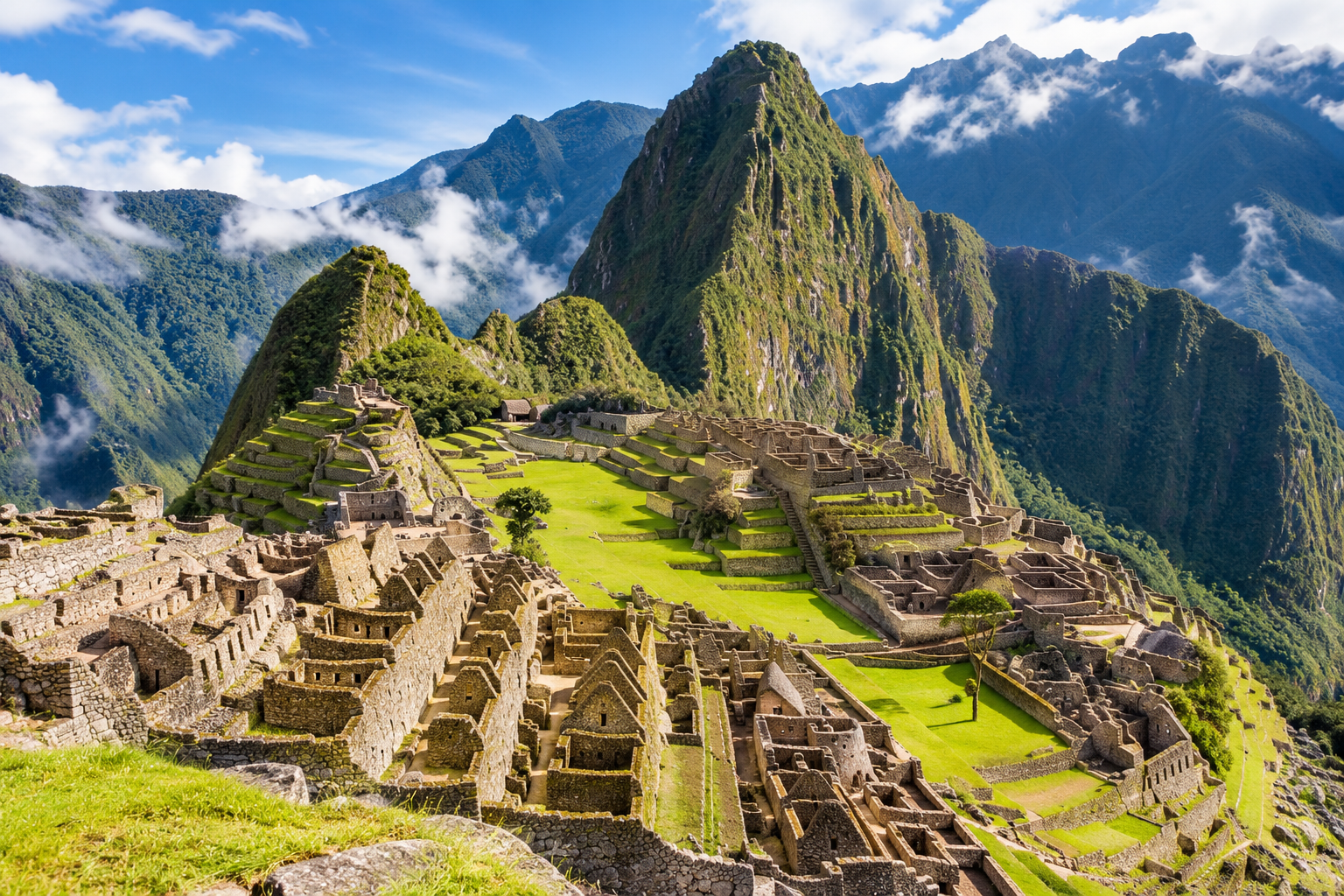
High in the Andes Mountains of Peru, surrounded by dramatic green peaks and tropical mountain forests, stands Machu Picchu, one of the world's most remarkable archaeological sites. Its precisely fitted stone walls, agricultural terraces, ceremonial structures, and extraordinary natural setting demonstrate the remarkable achievements of the ancient Inca civilization.
Located approximately 2,430 metres above sea level, Machu Picchu is more than an ancient city. It represents a sophisticated relationship between human creativity and the natural environment. UNESCO inscribed the Historic Sanctuary of Machu Picchu on the World Heritage List in 1983, recognising its exceptional cultural and natural significance.
Machu Picchu: Key Facts
- Location: Peru, South America
- Civilization: Inca civilization
- Construction: Primarily associated with the 15th century
- Elevation: Approximately 2,430 metres above sea level
- UNESCO inscription: 1983
- Heritage classification: Mixed Cultural and Natural
- UNESCO criteria: (i), (iii), (vii), and (ix)
- International recognition: Hiram Bingham's 1911 expedition brought the site to wider international attention
1. The History of Machu Picchu
The Rise of the Inca Civilization
The Inca civilization developed in the Andean region of South America and established a powerful empire during the 15th and early 16th centuries. Its political and administrative centre was Cusco, in present-day Peru.
The Incas developed sophisticated systems of agriculture, road construction, stone masonry, administration, and religious practice. Despite the challenging mountain environment, they built settlements, irrigation channels, agricultural terraces, and an extensive network of roads connecting distant parts of their empire. Machu Picchu emerged during this period of remarkable expansion.
Who Built Machu Picchu?
Machu Picchu is generally associated with the Inca ruler Pachacuti, who reigned during the 15th century and played a major role in expanding the Inca Empire. Archaeological interpretations commonly place the site's construction and principal use in this period, although scholars continue to investigate its precise chronology and original purpose.
The site contains approximately 200 structures, including residential buildings, ceremonial spaces, agricultural facilities, and other architectural features. Its carefully planned layout indicates that the settlement supported organised and specialised activities.
Why Was Machu Picchu Built?
The exact purpose of Machu Picchu remains a subject of scholarly discussion. Researchers have proposed that it served as a royal estate, a ceremonial centre, a religious sanctuary, or a combination of these functions.
Its architecture and geographical position suggest that religious beliefs, political authority, agriculture, and astronomical observations may have influenced its design. However, no single explanation has conclusively resolved every question about the site's original role.
The Spanish Conquest and Abandonment
During the 16th century, Spanish forces conquered the Inca Empire. The resulting political and social changes contributed to the abandonment of several Inca settlements. Machu Picchu was abandoned or substantially depopulated during this period, although the precise circumstances remain debated.
Its relative isolation helped preserve many of its architectural remains while vegetation gradually covered parts of the site. The settlement's survival provides modern researchers with valuable evidence of Inca engineering, urban planning, and land use.
The International Recognition of 1911
In 1911, American explorer and historian Hiram Bingham brought Machu Picchu to wider international attention through an expedition supported by Yale University and National Geographic. His work helped introduce the archaeological complex to a global audience.
However, local people already knew of the area before Bingham's expedition. Therefore, describing him as the first person ever to discover Machu Picchu would be misleading. Subsequent archaeological research, excavation, and conservation helped establish the site's international reputation.
2. The Remarkable Architecture of Machu Picchu
Machu Picchu is widely regarded as a masterpiece of Inca architecture and engineering. Its builders adapted the settlement to a steep mountain ridge, integrating buildings, pathways, and terraces with the surrounding terrain.
Precision Stone Masonry
One of the site's most striking features is its stone construction. Many walls consist of carefully shaped stones fitted closely together without conventional mortar. This technique required considerable craftsmanship and knowledge of stoneworking.
The construction techniques also helped some structures accommodate movement and stress, an important consideration in a mountainous region affected by earthquakes. The result demonstrates the Incas' ability to combine practical engineering with architectural sophistication.
Agricultural Terraces
Extensive agricultural terraces extend along the mountain slopes. They created usable growing areas on steep terrain and helped manage soil and water. Terraced agriculture was particularly valuable in the Andes, where elevation, slope, rainfall, and local climate created challenging farming conditions.
These terraces represent both an agricultural achievement and an example of adapting human activity to the natural environment.
Urban Planning and Water Management
Machu Picchu was organised into residential, ceremonial, and agricultural areas. Buildings, stairways, terraces, pathways, and open spaces formed a planned settlement rather than a randomly developed collection of structures.
Water channels and drainage arrangements helped support daily life in a difficult mountain environment. These systems illustrate how the Incas managed water distribution, rainfall, and the practical needs of a high-altitude settlement.
3. Machu Picchu and UNESCO World Heritage Status
UNESCO inscribed the Historic Sanctuary of Machu Picchu on the World Heritage List in 1983. The property is particularly significant because it is classified as a Mixed World Heritage Site, recognised for both cultural and natural values.
According to the UNESCO World Heritage Centre, the property covers approximately 38,160.87 hectares of mountain slopes, peaks, valleys, archaeological remains, and natural habitats. Its significance extends beyond historic buildings to include the relationship between human settlement, engineering, agriculture, and the surrounding ecosystem.
UNESCO recognised Machu Picchu under four selection criteria: (i), (iii), (vii), and (ix). Each criterion represents a distinct dimension of the site's Outstanding Universal Value.
4. The Four UNESCO World Heritage Criteria Explained
Criterion (i): A Masterpiece of Human Creative Genius
Criterion (i) recognises Machu Picchu as a masterpiece of human creative genius. Its architectural and engineering achievements are exceptional because the Incas integrated sophisticated construction with a dramatic mountain landscape.
The stone structures, agricultural terraces, and pathways demonstrate technical skill and the ability to adapt to challenging geographical conditions. Machu Picchu is an outstanding example of the artistic and engineering capabilities of the Inca civilization.
Criterion (iii): A Unique Testimony to a Cultural Tradition
Criterion (iii) recognises Machu Picchu as an exceptional testimony to the Inca civilization. Its archaeological remains provide evidence of social organisation, religious practices, agricultural production, administrative functions, and territorial control.
The settlement's planned layout helps researchers understand how the Incas organised activities within a complex mountain environment. Its remains continue to support archaeological investigation into this important pre-Columbian civilization.
Criterion (vii): Exceptional Natural Beauty
Criterion (vii) recognises Machu Picchu for its exceptional natural beauty and striking landscape. Its archaeological structures stand amid steep mountain peaks, deep valleys, and lush vegetation.
The visual relationship between the built environment and the surrounding Andes creates a landscape of extraordinary scenic quality. This criterion highlights the importance of the natural setting alongside the site's historic architecture.
Criterion (ix): Significant Ecological Processes
Criterion (ix) recognises Machu Picchu for its importance in representing significant ecological and biological processes. The sanctuary lies in a transition zone between the high Andes and the Amazon Basin.
Changes in altitude and climate create diverse microclimates and habitats. These environments support a wide variety of plant and animal communities, including species with restricted geographical distributions. The property therefore contributes to biodiversity conservation in a globally significant region.
Why Are These Criteria Important?
Together, the four criteria explain why Machu Picchu is not simply an ancient settlement. Criterion (i) highlights creative and engineering excellence; criterion (iii) emphasises cultural testimony; criterion (vii) recognises exceptional natural beauty; and criterion (ix) focuses on ecological processes and biodiversity.
Their combination establishes Machu Picchu's distinctive status as a mixed cultural and natural World Heritage property.
5. The Natural Environment and Biodiversity
The Historic Sanctuary of Machu Picchu occupies a remarkable geographical position on the eastern slopes of the Andes, near the upper Amazon region. Variation in altitude creates several ecological zones, ranging from high-altitude grasslands to montane cloud forests and lower tropical forest environments.
These habitats support diverse plant life, including orchids, ferns, and other species adapted to different environmental conditions. The wider region also provides habitat for a range of birds, mammals, amphibians, and other wildlife.
The sanctuary's biodiversity is particularly important because some species are endemic or have limited distributions. Protecting Machu Picchu therefore requires more than preserving stone buildings. Conservation efforts must also maintain forest ecosystems, water quality, wildlife habitats, and ecological connections across the landscape.
6. Challenges in Protecting Machu Picchu
Tourism Pressure
Tourism generates economic benefits and supports employment, but large numbers of visitors can place pressure on archaeological structures, pathways, sanitation systems, and surrounding ecosystems. Effective visitor management is essential to balance public access with long-term conservation.
Environmental Degradation
Potential threats include deforestation, pollution, poorly managed waste, agricultural encroachment, and the introduction of non-native species. These pressures can damage habitats and undermine the ecological values for which the sanctuary is recognised.
Natural Hazards
Machu Picchu lies in a mountainous region exposed to heavy rainfall, landslides, erosion, and other natural hazards. Its terrain and climate can complicate the maintenance of infrastructure and the protection of archaeological remains. Conservation planning must account for both environmental change and physical vulnerability.
Sustainable Management
Protecting Machu Picchu requires coordination among government agencies, conservation specialists, local communities, and tourism operators. Long-term strategies should include scientific monitoring, responsible visitor management, ecosystem restoration, improved waste treatment, and appropriate reinvestment of tourism revenue in conservation.
The objective is to preserve the site's cultural and natural significance while allowing future generations to study and experience it.
7. Why Machu Picchu Matters Today
Machu Picchu remains important for several reasons. First, it provides evidence of the sophistication of pre-Columbian American civilizations. Its architecture and infrastructure demonstrate the technological capabilities of a society that developed without modern machinery.
Second, the site illustrates how human communities can adapt to difficult geographical conditions through careful planning and environmental knowledge. Its agricultural terraces, stone structures, and water management systems offer valuable subjects for research.
Third, its mixed heritage status highlights the connection between cultural conservation and biodiversity protection. Finally, Machu Picchu contributes to education, scientific research, tourism, and the cultural identity of Peru.
Conclusion
Machu Picchu is one of the most remarkable surviving achievements of the Inca civilization. Built primarily during the 15th century, it combines sophisticated stone architecture, agricultural terraces, organised urban spaces, and carefully adapted infrastructure within an extraordinary mountain landscape.
Its inscription on the UNESCO World Heritage List in 1983 recognised four distinct aspects of its importance: creative genius, cultural testimony, natural beauty, and ecological significance.